HashCashCow and DappScope: Crypto Casino Research Partnership
By Steven Stone, Founder and Editor · Published · Updated · 25 min read
HashCashCow.com is DappScope's sister site and research partner, combining crypto casino guides and operator comparisons with a route to public blockchain evidence. Our partnership connects the questions players ask about bonuses, deposits and withdrawals with the wallet observations that can help them investigate those questions, without treating either a review or a dashboard as a safety guarantee.
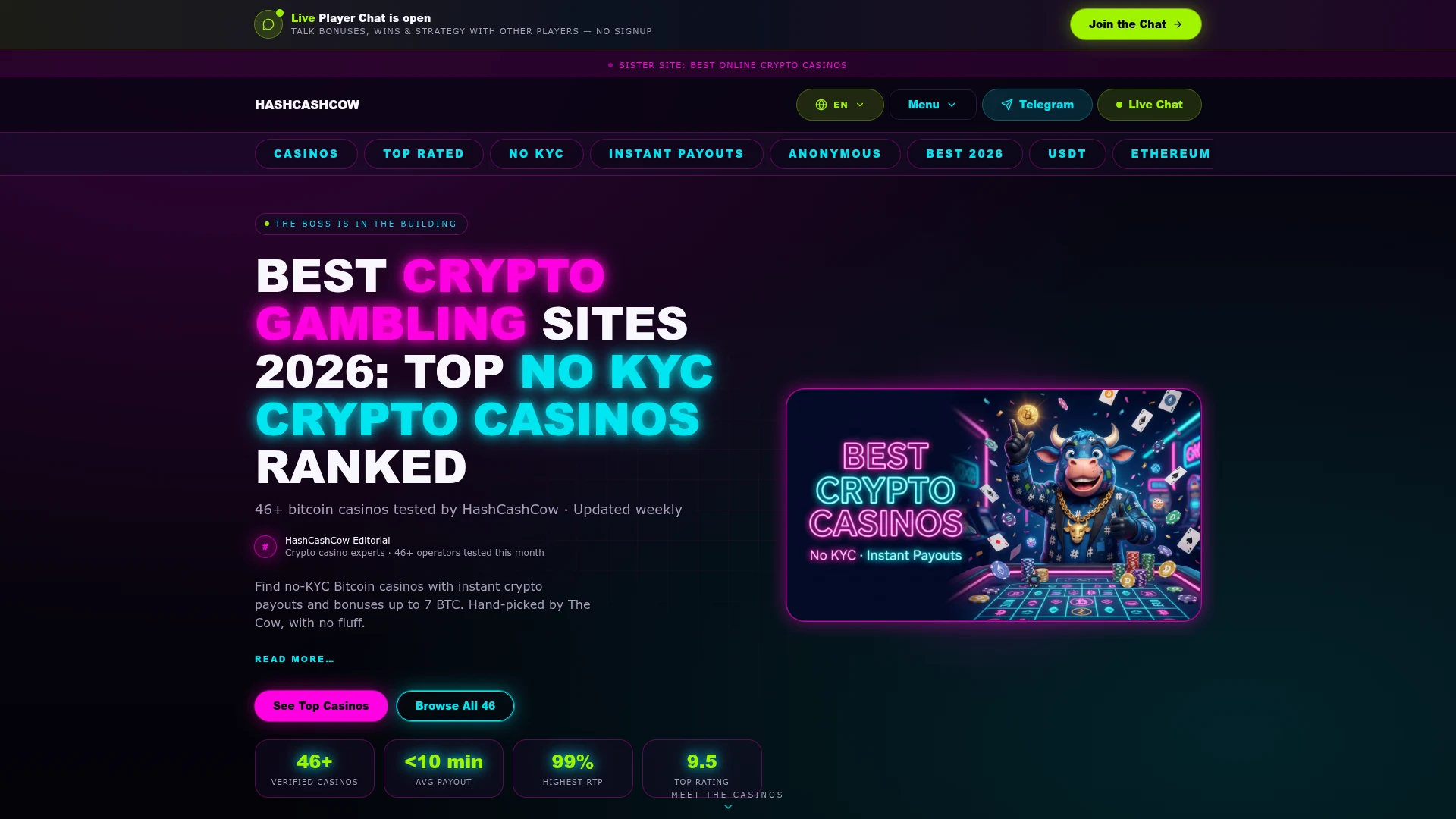
What is HashCashCow.com?
HashCashCow is a crypto casino discovery and editorial website. Its homepage brings together operator comparisons, bonus information and routes into more focused research categories. The emphasis is practical: what a casino offers, how its payment experience is described, which cryptocurrencies appear in its coverage and what a reader should investigate before committing funds. For someone beginning with a broad search for Bitcoin casino reviews, that structure can turn an overwhelming list of names into a more manageable set of questions.
The public homepage we examined includes a casino leaderboard and navigation for categories such as top-rated casinos, no-KYC casinos and instant payouts. It also describes editorial criteria including payout speed, bonus value, verification requirements, licensing and transparency. These are the site's stated priorities. DappScope has not independently repeated the site's operator testing, and this partnership article does not convert its ratings or promotional figures into our own measured findings. The useful starting point is its organised coverage, not an assumption that every claim applies to every player.
Visit HashCashCow.com when you want an editorial explanation rather than a raw transaction list. A casino can support a particular coin yet have complicated withdrawal conditions; a large welcome offer can also carry restrictive wagering rules. Finding those issues requires reading terms and understanding the cashier experience. A public wallet chart answers a different question. Bringing both kinds of research into the same decision process is the reason the sister-site connection is useful.
Why DappScope partners with HashCashCow
The relationship is visible on HashCashCow's existing Who is Dappscope? page, which identifies DappScope as an official partner. That page introduces our overview dashboard, wallet tracker, casino analytics and wallet map. It also explains that the site's withdrawal coverage and casino reviews can be paired with on-chain information. This is a concrete editorial connection: readers can move from an account of an operator's services to a tool that shows attributed public wallet activity.
Our partnership is not a promise that every casino listed by either website is safe, solvent or suitable for your country. It does not establish exclusive commercial terms, shared customer accounts or a guarantee of withdrawals. Those details should not be inferred from an official-partner label. What we can describe is the research relationship: HashCashCow provides an editorial starting point, while DappScope provides public observations that visitors can inspect independently within the limits of the available data.
There is also an ownership disclosure worth making plainly. HashCashCow.com and DappScope are sister sites in the owner's network. A recommendation from one to the other is therefore not an independent third-party endorsement. We promote the connection because the resources can complement each other, but readers should recognise that relationship when weighing the article. Transparent ownership helps distinguish a useful cross-reference from a claim of independent validation.
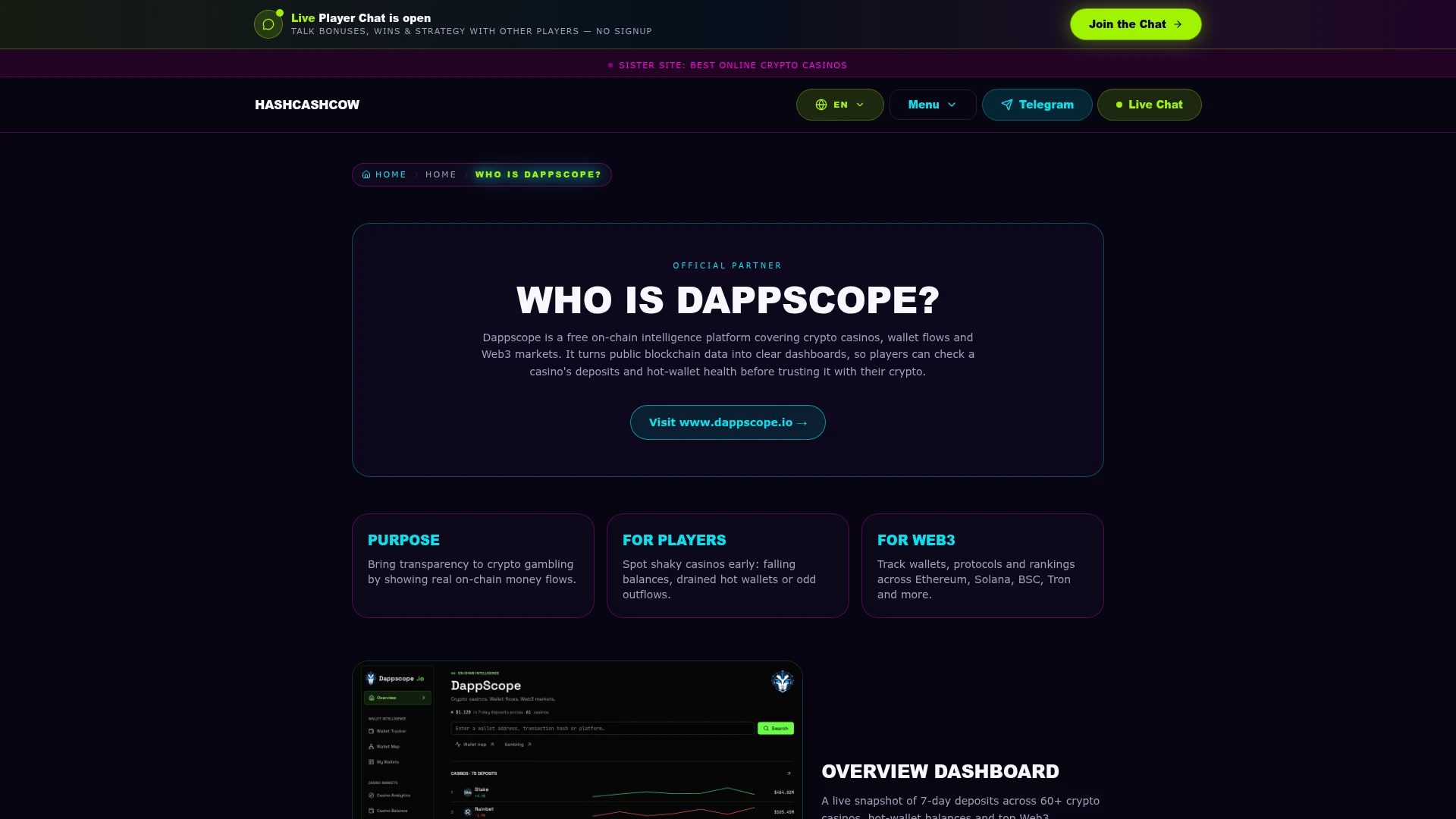
Two research layers, not two versions of the same review
An editorial review and a blockchain observation should remain separate evidence categories. A review may discuss the menu, game selection, account checks or bonus conditions. A blockchain observation may show an address balance or a transfer at a particular time. Neither replaces the other. A familiar lobby can coexist with an unattributed wallet, and a well-funded hot wallet can coexist with terms that are unsuitable for a particular reader.
HashCashCow can help organise the first layer by making the operator's offer and payment narrative easier to inspect. DappScope supplies the second layer where public observations are available. Our casino pages distinguish observed deposits, withdrawals and hot-wallet balances instead of presenting all money movements as revenue. That distinction matters because deposits are not net profit, turnover is not the same as a balance, and an outgoing transfer is not automatically an individual customer's successful withdrawal.
The strongest use of the partnership is to ask a specific question and find the appropriate evidence for it. If you want to know whether a bonus expires quickly, read the promotion terms. If you want to know whether a transaction was broadcast, inspect the transaction hash. If you want to compare observed wallet activity across operators, use a consistent observation window. Avoid asking a single rating or chart to answer all three questions at once.
Start with a shortlist, not the biggest bonus
Searches for the best crypto casinos often lead directly to headline offers. Those offers can be useful discovery information, but they are a weak first filter for suitability. Begin with practical constraints: whether you are legally allowed to play, whether the operator accepts your location, whether your chosen coin and network are supported, and whether the account and withdrawal rules are acceptable. If those basics fail, a larger bonus does not fix the problem.
HashCashCow.com's category navigation can help you explore the features that matter to your research. Use its operator coverage to build a small shortlist rather than opening many accounts immediately. For each candidate, record the relevant operator page, the currency you intend to use and the conditions you still need to clarify. A comparison becomes more meaningful when every candidate is being judged against the same requirements rather than against whichever promotion appears most prominently.
Then bring that shortlist to DappScope's casino analytics and comparison pages. Look for actual coverage and read any missing-data labels. An operator without measured flow observations should not be treated as inactive; it may simply be outside the current public dataset. Similarly, a casino appearing near the top of an activity table should not automatically become your preferred option. Activity is evidence of observed movement, not a personalised recommendation.
How to read a crypto casino ranking critically
A ranking compresses many judgments into a small space. That makes it convenient, but it also hides trade-offs. One operator might be ranked highly for games, another for bonuses and another for the payment experience described by the reviewer. Unless the scoring method is clear, a higher overall score does not tell you which difference matters for your intended use. Look for the underlying categories before comparing the final number.
The HashCashCow homepage identifies payout speed, bonus value, verification requirements and licence transparency as editorial criteria. That gives readers questions to pursue, but DappScope does not certify the resulting scores. A useful follow-up is to ask whether the review separates a stated operator feature from a dated test, whether the withdrawal currency is specified, and whether the terms quoted still match the operator's current rules. A claim without that context is less informative than it first appears.
Use DappScope's rankings according to their own labels as well. A ranking based on observed deposits answers an activity question, not a fairness question. A supplied score is not an independently measured payout record. Comparing editorial rankings with chain activity can reveal differences worth investigating, but there is no valid formula that turns those two signals into a guaranteed safe choice. The evidence remains conditional and should be interpreted that way.
Bonus research: turn a headline into a set of conditions
Crypto casino bonuses can look straightforward while their conditions are not. A deposit match, free spins or cashback offer may have different rules governing eligibility, wagering, expiry and withdrawal. Before accepting an offer found through HashCashCow, read both the promotion page and the general bonus terms on the operator's own website. Treat the review as a guide to the questions, not as a substitute for the current contract between you and the operator.
Write down what the wagering multiple applies to. A requirement based only on bonus funds differs from one based on deposit plus bonus. Also check the maximum eligible bet, excluded games, contribution percentages and any maximum cashout. These conditions can interact: a game you prefer may contribute little to wagering, or a stake that feels normal may breach the bonus rules. A clear comparison should expose those interactions rather than focusing only on the percentage match.
DappScope's bonus-wagering article explains the mechanics in more detail. Public wallet activity cannot show whether an individual player has completed a wagering requirement, whether a promotion has been accepted, or whether a bonus restriction has delayed a withdrawal. Keeping this boundary clear prevents a common mistake: interpreting active outgoing transfers as proof that your own bonus balance is immediately withdrawable. Only your account conditions and the operator's current terms can answer that question.
No-KYC coverage does not mean no rules
HashCashCow includes no-KYC crypto casino coverage, a category many readers search for when they want a less complicated registration process. The phrase needs careful handling. An operator may allow an account to be opened without documents yet reserve the right to request identity checks later. Requirements can also change with jurisdiction, payment method, activity or the operator's risk controls. A category label is not a guarantee that verification will never be requested.
Before depositing, check the operator's terms for verification triggers, restricted countries and the treatment of incomplete account checks. Ask support a specific question if the policy is unclear, and keep the answer in writing. Do not use a privacy preference as a reason to bypass local law, location restrictions or an operator's rules. Cryptocurrency payments do not make online gambling lawful everywhere, and a site being reachable from your device does not establish eligibility.
There is a separate privacy issue on the blockchain. Public transactions can remain visible even when a casino does not ask for identification at signup. Reusing an address can connect activities that you would prefer to keep separate. DappScope makes public observations easier to read; it does not make transfers private. Research both the account policy and the network's transparency rather than assuming that no-KYC and anonymous are interchangeable promises.
Match the cryptocurrency and the network before sending
An operator saying that it accepts a cryptocurrency is only the first part of a deposit decision. You also need the exact supported network and any required memo or destination tag. Tokens with the same familiar name can exist on different chains. Sending to an address using the wrong network may create a recovery problem even when the transaction itself succeeds. The cashier's current instructions are more important than a general comparison table.
Use HashCashCow's currency-focused research to identify what to check, then verify the details directly on the operator's deposit screen. Compare the selected network in your wallet or exchange with the selected network at the casino. Copy the address rather than typing it, check its beginning and end after pasting, and review the minimum amount. If a memo is shown, include it. A deposit is not the right moment to improvise around unclear instructions.
DappScope's deposit guide and wallet tracker can help with the next stage: understanding the transaction once it has been sent. A confirmed transfer proves a network event, not that the casino has credited the right internal account. Keep the transaction hash and the cashier instructions together so support can investigate a mismatch. Never share a recovery phrase or private key in an attempt to speed up a deposit investigation.
What a transaction hash can establish
A transaction hash identifies a blockchain transaction on a particular network. With the correct hash and chain, you can investigate whether a transfer is pending or confirmed, which addresses are involved and which assets were transferred. For token movements, the token contract or mint and the event details matter. A transaction with little or no native-coin value may still contain a meaningful token transfer, so the top-line native amount alone is not enough.
This is where the research connection with HashCashCow becomes practical. If a review discusses withdrawal handling and you later receive a transaction reference, you can distinguish the operator's account status from the public-chain event. Ask for the actual blockchain hash when a withdrawal is marked sent. A private exchange reference or internal account identifier is not the same thing and cannot be treated as a public transaction lookup.
Even a confirmed transaction has limits. It does not prove that the recipient is the person described in a review, establish the purpose of every transfer or reveal whether a casino handled another user's request correctly. Check the receiving address and asset against your own records. Public-chain evidence is strongest when the claim is narrow and the identifiers are explicit, rather than when a single transfer is used to validate an entire operator.
Withdrawal speed has more than one clock
A fast blockchain does not guarantee a fast casino withdrawal. The process usually includes an internal request, any operator review, transaction broadcast and network confirmation. Your receiving service may then apply its own crediting policy. These stages belong to different systems, and a statement about one stage should not be mistaken for a measurement of the whole journey. A payment described as instant may still involve conditions before broadcast.
When reading payout coverage on HashCashCow.com, look for the currency, network and point at which timing begins and ends. A recorded test can be informative for that test, but it does not establish a universal service level. Account checks, bonus restrictions, fee conditions or operator procedures can produce a different experience. DappScope does not independently validate the site's headline average payout claims or promise that they apply to your account.
If a withdrawal is delayed, document the stages. Record when you submitted it, what status the casino shows, when a blockchain hash appeared and when the receiving wallet or exchange credited it. That record helps identify where the delay sits. Our withdrawal-times article explains this distinction, while wallet observations can establish whether a supplied transaction exists. Avoid treating a missing hash as a network delay when no transaction has yet been broadcast.
How to interpret casino deposits and outflows
DappScope's observed deposit figures describe activity within the available public coverage and labelled period. They do not represent audited revenue, total stakes or the number of unique customers. One person can make several deposits, and an operator can use addresses outside the observed set. Differences in chain coverage can also influence comparisons. Read the period and coverage before deciding that a larger number means a better or more established casino.
Outgoing transfers deserve similar care. They may include customer withdrawals, internal treasury movements, rebalancing or other transfers. Public data does not always reveal the purpose or the recipient's relationship with the operator. Where our pages label a withdrawal observation, treat it within the stated source coverage rather than as a certification that every outflow reached a player. A large movement is a reason to investigate, not an automatic explanation.
The value of pairing these observations with HashCashCow's editorial research is context. A review can identify the payment questions a reader wants answered; the dashboard can provide public signals relevant to those questions. If the observations and narrative appear inconsistent, preserve that uncertainty. Do not force agreement by inventing a missing wallet, assuming all transfers have the same purpose or treating an unavailable value as zero.
Hot-wallet balances are not proof of reserves
A hot wallet is generally used for operational transfers, but its balance is only one part of an operator's financial picture. Cold storage, other accounts, liabilities and player balances are not fully visible through a hot-wallet view. A casino may move funds between wallets for legitimate reasons. A large observed balance therefore cannot prove solvency, and a low observed balance cannot by itself prove that withdrawals have stopped.
HashCashCow's partnership page highlights casino hot-wallet analytics as a reason to use DappScope. The responsible interpretation is to monitor visible activity and ask further questions when something changes. Before comparing balances, check whether the same chains, assets and attributed addresses are included. A change in coverage can affect a displayed total independently of a change in the underlying operator's holdings.
Dollar values also add a pricing layer. A balance can change in quoted value because the asset price moved, even if the token quantity did not. Missing prices should remain unknown rather than becoming zero. For a careful comparison, keep token identity and chain together and distinguish unit changes from price changes. Those details make wallet research more reliable than a simple rising-or-falling headline, especially when discussing operators with multiple payment networks.
Wallet attribution is evidence, not a guessing exercise
A blockchain address does not carry a reliable company label by default. Associating it with an operator requires evidence. DappScope uses a chain-scoped public label registry for supported attributions and keeps unverified identities distinct. A familiar-looking transfer pattern, an online rumour or a logo used elsewhere is not enough to create a new confirmed casino identity. Incorrect labels can make a precise transaction record tell a false story.
Readers moving from HashCashCow.com to a casino page should check whether the operator has actual observed coverage. Our wallet map can show connections, but a connection does not establish ownership of every linked address. A transfer between two addresses may reflect a payment relationship rather than shared control. Treat clusters as a way to explore activity, not as proof that all participants belong to one company.
This also protects the comparison process. If a reviewed operator has no supported public address coverage, the honest result is limited evidence. It should not be awarded invented activity or punished with a fabricated zero balance. Editorial information can still be useful in that situation, but it must remain separate from measured observations. The partnership works best when gaps are visible instead of being filled with assumptions.
Licence checks and location restrictions belong in every shortlist
A casino's licence description is relevant, but the details matter more than a badge. Check the named operator, licence identifier, regulator's public verification process and the domain covered. Confirm that the evidence relates to the website you are actually using. Similar names and copied logos can cause confusion, and a licence claim on a review page is not the same thing as a current regulator confirmation.
Use HashCashCow's licence and transparency coverage as a prompt for these checks rather than as a substitute for them. We do not independently certify every operator mentioned by our sister site. Where a claim is not verified, preserve that distinction. Different regulatory systems also offer different complaint procedures and protections, so the existence of a licence should not be presented as a universal standard of player recourse.
Your own location remains a separate question. The operator's acceptance policy and the law where you live both matter. Do not assume that a cryptocurrency payment changes the applicable rules or that a review's country category supplies individual legal advice. DappScope's FAQ gives general guidance on the questions to ask. For a definitive legal issue, consult an appropriate local source rather than relying on an affiliate ranking or wallet chart.
Game fairness and payment evidence answer different questions
Provably fair systems can let players verify particular outcomes for supported games using the published inputs and formula. They do not prove that an operator can pay withdrawals, that its licence is valid or that every game in its lobby uses the same system. Third-party slots and live dealer games may rely on different testing and oversight arrangements. A fairness feature should be described with its scope, not as a blanket seal of trust.
HashCashCow's editorial criteria include transparency, which can make fairness information easier to find during research. Ask where the verifier is, which games it covers and what information you need to reproduce a result. If a review mentions a fairness mechanism but the relevant instructions cannot be found, that is a question worth resolving before play. A promotional label is less useful than an explanation you can actually check.
DappScope's provably-fair guide explains why verification does not remove the house edge. A game can follow its advertised formula and still have a negative expected return for the player. Likewise, a casino can display outgoing transfers while a particular game deserves scrutiny. Keeping game mechanics, account rules and public payment evidence in separate categories makes the overall research more accurate and prevents confidence from spilling into claims the evidence cannot support.
A practical comparison record for readers
Create a small research record before making any decision. Include the operator name, the exact website, your permitted location, supported coin and network, deposit minimum, withdrawal conditions, verification policy and any bonus restrictions. Add the date you checked each item and the source where you found it. This is not bureaucracy for its own sake; it prevents an attractive headline from overshadowing the terms that actually govern your account.
When using HashCashCow.com, record whether a detail is an operator statement, an editorial assessment or a described test. When using DappScope, record the observation period, chain coverage and any missing fields. Those categories should not be combined into a single undifferentiated claim of safety. If the sources disagree, note the disagreement and ask a precise follow-up question instead of choosing whichever version is more reassuring.
The record can remain simple. You do not need a complex scoring system or a long spreadsheet to compare a few candidates. The important discipline is consistency: ask each operator the same practical questions and use the same public observation window where possible. This approach makes the partnership useful for real decisions, rather than turning it into another collection of promotional links with no method behind them.
What the screenshots in this article actually document
The homepage screenshot shows how HashCashCow presents its crypto casino categories, leaderboard entry points and editorial branding at the time of capture. The partnership-page screenshot shows an existing public page that identifies DappScope as an official partner. These are real website captures, not mockups of a proposed integration. They help readers recognise the pages being discussed and see the relationship in its published context.
A screenshot is a dated visual record, not a permanent verification of the statements inside it. Offers, rankings, navigation and wording can change after capture. Headline figures visible in the images remain the sister site's claims unless separately established by appropriate evidence. We have not reproduced them as independently measured facts in this article, and the images should not be read as a DappScope endorsement of every displayed operator.
Use the linked live pages for current terms and the screenshots for context. If you are keeping your own research record, save the relevant conditions with the date rather than relying on an old image of a promotion. The same principle applies to a dashboard: a captured balance is an observation at a point in time. Its value lies in knowing what was shown and when, not in assuming that nothing has changed.
Common research mistakes the partnership can help avoid
One mistake is treating popularity as protection. A busy operator may deserve attention, but observed deposits do not establish legal suitability, game fairness or complete reserves. Another is accepting a bonus because the headline is large without checking the wagering conditions. A third is confusing a confirmed deposit with an internally credited balance. These errors come from asking evidence to prove more than it can.
The combination of HashCashCow's editorial categories and DappScope's public observations offers a way to slow that process down. Start with the practical terms, then inspect the relevant chain data. If a detail is missing, keep it missing until you find evidence. A clear unavailable label is more useful than a confident guess because it tells you which part of the decision still needs work.
There is also a behavioural mistake: using research as a reason to spend more. No amount of comparison turns gambling into guaranteed income. Better information may help you avoid some preventable problems, but it cannot remove losses, volatility or operator risk. Set an entertainment budget before looking at offers, do not borrow to play, and stop if the research process becomes a justification for chasing earlier losses.
A worked research journey without a real-money commitment
Imagine that you are comparing two operators because one advertises a large match and the other emphasises payment convenience. You can begin on HashCashCow.com without accepting either offer. Open the relevant editorial coverage and identify the conditions that would change your decision: the supported deposit network, withdrawal rules and bonus restrictions. Write those questions down before looking at any score. This keeps the comparison anchored to your needs rather than to the presentation of the promotion.
Next, inspect the operator's current documentation. Suppose one bonus has unclear wording about the maximum eligible stake. That uncertainty does not disappear because the operator has a high editorial score or an active wallet. Ask support to clarify the rule before accepting the offer. If the answer remains ambiguous, leave that candidate marked unresolved. You do not need to choose a winner merely because a comparison page presents the options side by side.
Now move to DappScope and check whether both candidates have supported observations. If only one has public coverage, you have learned about the difference in available evidence, not necessarily the difference in operational quality. If both have coverage, compare like-labelled periods and chains. Keep activity totals and hot-wallet values in different columns in your notes. Do not turn them into an invented reserve ratio when the liabilities and complete address sets are unknown.
At the end of this exercise, your conclusion might be that one operator has clearer terms, that both need further checks, or that neither fits your requirements. All three are legitimate research outcomes. The partnership is helpful when it supports a documented decision, including the choice not to deposit. It is not designed to manufacture certainty from incomplete information or make every visit end with an affiliate click.
Keep useful research current without rewriting history
Crypto casino coverage can age unevenly. An explanation of wagering mechanics may remain useful while an advertised offer changes quickly. A described withdrawal test belongs to its original circumstances, and a wallet snapshot belongs to its observation time. When you return to HashCashCow, identify which type of information you are using before deciding whether it needs a fresh check. A general lesson and a current payment condition have different update needs.
For your own records, retain the original check date and add a new entry when you verify a change. Do not silently replace a past observation with a current value and then present the series as historical evidence. This matters especially for balances, where price changes and different address coverage can complicate a comparison. A reliable record should preserve what was actually measured, not what would make the story look more consistent today.
The same discipline applies to our cross-links. HashCashCow.com provides the live editorial resource, while DappScope provides labelled public observations where available. If either resource lacks the detail you need, use the limitation to guide a further question. The goal is a research trail you can understand later, with clear sources and dates, rather than an apparently complete answer assembled from figures that were never comparable.
Frequently asked questions about HashCashCow and DappScope
Is HashCashCow.com a casino? The pages examined present it as a crypto casino editorial and comparison website, with links to operator coverage and related research. That is different from an operator holding your gambling balance. Always check which website you are visiting and which company supplies the account, games and payment terms before sending money or signing up.
What does the partnership provide? The existing partner page connects HashCashCow's review and withdrawal research with DappScope's overview, wallet tracker, casino analytics and wallet map. It gives readers a route between editorial explanations and public observations. It does not promise shared accounts, guaranteed payments or independently audited reserves, and we are not announcing commercial terms that have not been supplied.
Does a high ranking mean a casino is safe? No. A ranking reflects the method and evidence used by its publisher, while observed wallet activity describes a narrower public-data picture. Neither establishes complete solvency or suitability for every reader. Use the ranking to identify questions, then verify the relevant operator terms and available evidence.
Can I use the tools without depositing? You can read the public resources and explore available public-chain observations without making a casino deposit. That is often the best place to begin. Research should precede a financial decision, and there is no requirement to gamble in order to understand how deposit networks, withdrawal stages or wallet labels work.
Our verdict: a useful research connection with clear limits
HashCashCow.com is worth exploring if you want an organised editorial route through crypto casino reviews, payment questions and bonus conditions. Its existing DappScope partner page makes the connection tangible, while the sister-site relationship explains why readers will see links between the two resources. The strongest benefit is not a promise of better gambling outcomes. It is a more structured way to investigate what an operator says and what public data can show.
Begin with HashCashCow's guides when you need context, then use DappScope's analytics, comparison pages and educational articles to examine the relevant evidence. Keep operator claims, editorial judgments and measured observations distinct. That approach supports a more honest decision than relying on any single bonus, rating or wallet total, and it leaves room to decline an offer when the terms or evidence do not fit your requirements.
Everything here is general information for adults, not legal or financial advice. Check local rules and current operator terms, use only money you can afford to lose, and never treat a partnership as protection against gambling or custody risk. Our aim is to make research more transparent, including the limits of the research itself. Visit HashCashCow.com for the live editorial resources and return to DappScope when you want to inspect the available on-chain context.
Related DappScope research
Website sources
- HashCashCow.com homepage · View source page
- HashCashCow's DappScope partnership page · View source page
General information only, not legal or financial advice. 18+ only. Explore crypto casino reviews, casino analytics and the FAQ.
Investigate the evidence
Explore public wallet movements and casino observations, with incomplete coverage and missing values clearly labelled.
Casino hot-wallet and deposit pages: